
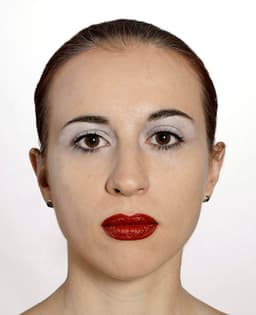
Prof. Dr.
Paula Muhr
Professor:in
Professor of Transdiciplinary Studies
Über mich
Paula Muhr is a visual artist and transdisciplinary researcher. She studied visual arts, art history, literary theory, and physics in Novi Sad, Belgrade, and Leipzig before receiving her PhD in Visual History from Humboldt University Berlin (From Photography to fMRI: Epistemic Functions of Images in Medical Research on Hysteria, transcript, 2022, open access). Her research lies at the intersection of visual studies, media studies, science and technology studies (STS), and the history and philosophy of science. She examines the knowledge-producing functions of imaging and visualisation technologies across the natural sciences, from neuroscience and medicine to physics, with a particular focus on artificial intelligence, including its potential benefits, risks, and societal challenges. Her research is increasingly conducted in collaboration with philosophers, neurologists, neuroscientists, psychiatrists, computer scientists, and sociologists. She is an active member of the History, Philosophy and Culture (HPC) Working Group of the Next Generation Event Horizon Telescope (ngEHT) Collaboration and an external affiliated researcher with the Human-Centered Health AI research group at the Idiap Research Institute.
Akademischer Werdegang
Dr. Phil.
From Photograhy to fMRI: Epistemic Functions of Images in Medical Research on Hysteria
Meisterschülerin
Hochschule für Graphik und Buchkunst Leipzig / Academy of Fine Arts Leipzig
Beruflicher Werdegang
Professor
Brand University of Applied Sciences Hamburg
Visiting Researcher
Institute of Philosophy, History of Literature, Science, and Technology, Technical University Berlin
Affiliated Researcher
Institute for Implementation Science in Health Care, Faculty of Medicine, University of Zurich
PostDoctoral Researcher
Institute for Implementation Science in Health Care, Faculty of Medicine, University of Zurich
Visiting Lecturer
University of Passau
PostDoctoral Researcher
Institute for History of Art and Architecture, Karlsruhe Institute of Technology (KIT)
Visual Artist
Self-employed
Curator for Photography
Student Cultural Centre Belgrade
Akademische Mitgliedschaften
History Philosophy and Culture (HPC) Working Group of the Next Generation Event Horizon Telescope (ngEHT) Collaboration
Member
stsing e.V. - Doing Science and Technology Studies in and through Germany
Member
stsing e.V. - Doing Science and Technology Studies in and through Germany
Board Member
Arbeitsgemeinschaft Funktionelle Neurologische Störungen (AG FNS)
Member
International Society for the History, Philosophy, and Social Studies of Biology (ISHPSSB)
Member
Transdisciplinary Thematic Research Network (TRN) Art Matters: Ästhetische Phänomene im Spannungsfeld von Mensch und Maschine, Universität Heidelberg
Member
History of Science Society
Member
European Association for the Study of Science and Technology (EASST)
Member
Human-Centered Health AI research group, Idiap Research Institute
External Affiliated Researcher
HaPoC - Commission for the History and Philosophy of Computing
Member
Publikationen
Splitting FND: Differences in Targeted Therapies for Functional Movement Disorders and Functional Seizures
Paula Muhr · 2026 · Social Science & Medicine
Paula Muhr · 2026 · In: Wissen und Gewalt (Thorsten Benkel and Ekkehard Coenen) · Beltz Juventa
Seeing Oneself Seize: A Case Study on the Affordances of a Video-Based Diagnostic Encounter for a Patient with Functional Seizures
Paula Muhr · 2026 · Culture Medicine and Psychiatry
Wissenschaft und Technologie kommunizieren: Kontroversität, Dialog und Partizipation.
Manuel Bolz, Stefanie Mallon, Paula Muhr, Tim Schaffarczik, and Philipp Schrögel · 2026 · transcript
Neurotechnology Through the Lens of Users and as a Novel Field for Society
Danesh Ashouri Vajari, Ludwig Weh, Vera Borrmann, Christopher Coenen, Eva Maria Kraft, Viviana Loufs, Wenzel Mehnert, Paula Muhr, …, and Thomas Stieglitz · 2026 · Social Science & Medicine
Search for Elusive Neuroimaging Biomarkers: Machine Learning, Resting-State fMRI, and the Reconfiguration of Diagnosis in Functional Neurological Disorder
Paula Muhr · 2025 · Digital Society
Establishing Trust in Algorithmic Results: Ground Truth Simulations and the First Empirical Images of a Black Hole
Paula Muhr · 2024 · In: The Science and Art of Simulation: Trust in Science, (Nico Formánek, Ammu Joshy, and Andreas Kaminski) · Springer · pp. 189–204
Evaluating Text-to-Image Generated Photorealistic Images of Human Anatomy
Paula Muhr, Yating Pan, Charlotte Tumescheit, Ann-Kathrin Kübler, Hatice Kübra Parmaksiz, Cheng Chen, Pablo Sebastián Bolaños Orozco, Soeren S. Lienkamp, Janna Hastings · 2024 · Cureus
What We Thought Was Unseeable’: Die mediale Konstruktion der ersten authentischen empirischen Bilder eines Schwarzen Lochs
Paula Muhr · 2024 · In: “Ain’t Nothing Like the Real Thing?”: Formen und Funktionen medialer Artefakt-Authentifizierung (Amrei Bahr and Gerrit Fröhlich,) · transcript · pp. 19–49
The ‘Cartographic Impulse’ and its Epistemic Gains in the Process of Iteratively Mapping M87’s Black Hole
Paula Muhr · 2023 · Media+Environment
The Unobserved Anatomy: Negotiating the Plausibility of AI-Based Reconstructions of Missing Brain Structures in Clinical MRI Scans
Paula Muhr · 2023 · In: Plausibilisierung und Evidenz: Dynamiken und Praktiken von der Antike bis zur Gegenwart (Antje Flüchter, Birte Förster, Britta Hochkirchen and Silke Schwandt) · Bielefeld University Press · pp. 169–192
From Photography to fMRI: Epistemic Functions of Images in Medical Research on Hysteria
Paula Muhr · 2022 · Image
Hysteria, a mysterious disease known since antiquity, is said to have ceased to exist. Challenging this commonly held view, this is the first cross-disciplinary study to examine the current functional neuroimaging research into hysteria and compare it to the nineteenth-century image-based research into the same disorder. Paula Muhr's central argument is that, both in the nineteenth-century and the current neurobiological research on hysteria, images have enabled researchers to generate new medical insights. Through detailed case studies, Muhr traces how different images, from photography to functional brain scans, have reshaped the historically situated medical understanding of this disorder that defies the mind-body dualism.
Tito/Tata: Fiction and Factuality in Documentary Photographs of the Father Figure in Communist Yugoslavia
Paula Muhr · 2021 · Refract An Open Access Visual Studies Journal
Ausgerichtete Konferenzen
Vorträge & Konferenzen
Extending the laboratory into everyday life: Biometric monitoring in research on functional neurological disorder
EASST2026 More than Now: Exploring Resilient Futures ↗
presenter · AGH University of Krakow, Krakw, Poland
Grotesque Bodies in AI-Generated Images: Iterative Prompting as an Artistic Method of Critical Analysis
Kunst, KI und rechte Dynamiken
presenter · Schirn Kunsthalle Frankfurt, Frankfurt / Germany
Applying Epidemiological Reasoning to Epistemic Dissent in Large-Scale Scientific Collaborations
2026 European Society for the History of Science/History of Science Society Joint Meeting ↗
presenter · University of Edinburgh, Edinburgh UK
Aesthetics of Solace, Politics of Care ↗
presenter · Kunsthistorisches Institut in Florenz – Max-Planck-Institut Florence, Florence, Italy
Weizenbaum Conference 2026: Generative AI and Society: What is at Stake? ↗
presenter · bUm – Raum für soziales Miteinander, Berlin, Germany
Noisy Systems: Aesthetics, Epistemology, and Computation ↗
presenter · Bibliotheca Hertziana – Max Planck Institute for Art History, Rome, Italy
Living with Inflammation: Inquiry into the Ontology and Politics of Flammability
presenter · Institute of Sociology of the Czech Academy of Sciences, Prague, Czech Republic
The Pivotal Images of Black Holes, Their Epistemic Power, and Retrospective Auratisation
Black Hole | Black Box: Limits, Opacity, and the Unknown Across Art, Science, and Media ↗
presenter · Bibliotheca Hertziana, Rome, Italy
Mapping the (Un)Knowable: The Productivity of Blank Spaces in Epistemic Images
Blank Space in the Perception and Epistemology of Maps ↗
presenter · Käte Hamburger Research Centre global dis:connect, LMU Munich, Munich, Germany
Reanalysing Black Hole Images: Algorithmic Reconstruction, Human Judgment, and Epistemic Critique
Philosophical and Technological Reflections on Contemporary Cosmology ↗
presenter · National Autonomous University of Mexico, Mexico City, Mexico
Intersecting Powers of AI-Generated Body Images: Insidious Influence, Normative Beauty, and Epistemic Exclusion
Generative AI & the Faces of Power
presenter · Weizenbaum Institute, Berlin, Germany
Functional Seizures and the Persistence of Historical Stereotypes of the ‘Difficult’ Patient
Critical Approaches to Like and Dislike in Medicine, Law, and Society
presenter · University of Bristol, Bristol, UK
Approaching the Patient as a Knowing Subject: Functional Seizures and the Video-Based Diagnostic Encounters
Cultivating Patients: Identities, Technologies, and Trading Zones of Patienthood
presenter · Uppsala University, Uppsala, Sweden
Shifting Frames in Neuroimaging Research on Hysteria/Functional Neurological Disorder from the 1990s to Today
Biennial conference of the International Society for the History, Philosophy, and Social Studies of Biology, ISHPSSB 2025
presenter · University of Porto, Porto, Portugal
The Burden of Visibility: Functional Seizures and the Relational Experience of Sham
Shame and Medicine
presenter · University of Exeter, Exeter, UK
The Epistemic Value of Erroneous Independent Reanalyses in EHT Black Hole Imaging
4th Workshop ngEHT History Philosophy Culture Working Group
presenter · Black Hole Initiative, Harvard University, Cambridge, MA, USA
Von der Fotografie zum Video – eine kultur- und bildwissenschaftliche Perspektive auf die medizinische Untersuchung von hysterischen (funktionellen) Anfällen
13. Dreiländertagung für Epileptologie
presenter · Salzburg, Austria
Probing Consciousness. EEG and the Neural Activity of the Dying Human Brain
Kulturen der Trauer und des Todes in Geschichte, Gegenwart und Zukunft
presenter · Aby-Warburg-Haus, Hamburg, Germany
Staging the Leaky Bodies: Pimple Popping Video on Social Media
The Leaky Body: A New Turn in the Humanities and Social Sciences?
presenter · University of Kent, canterbury, UK
Exploring How Images Operate Epistemically Across Natural Sciences
Medical Knowledge and Decision Support Group Meeting
presenter · University of Zurich, Zurich, Switzerland
Diagnosing Functional Neurological Disorder: Current Practice and iIs Historical Origins
Diagnosis Conference: Between Knowing and Doing
presenter · Medical Museion, Copenhagen, Denmark
Seeing and Understanding the ‘Unseeable’: The EHT Images of M87* Black Hole as Epistemic Tools
6th Scientific Understanding and Representation (SURe) Workshop
presenter · London School of Economics, London, UK
Splitting FND: Differences in Targeted Therapies for Functional Movement Disorders and Functional Seizures
MISFIRES & Targeting Therapies
presenter · University College Dublin, Dublin, Ireland
Performing In-Betweenness in Image Text Migrations
The Expanded Librarian Symposium
presenter · Centre for Research in the Arts, Social Sciences and Humanities (CRASSH), University of Cambridge, Cambridge, UK
with Sarah Blair, Laura Bivolar, Tom Rogers, and Sharon Young
Elusive Biomarkers: Epistemic Challenges of Training Classifiers to Identify Functional Neurological Disorder Based on fMRI Data
Politics of Machine Learning Evaluation,
presenter · Institute for Advanced Study, University of Amsterdam, Amsterdam, The Netherlands
Ausstellungen
Aftermath: Deconstructing Memories _ Paula Muhr and Hannah Becher
Other · Projektraum Zwitschermachine, Berlin, Germany
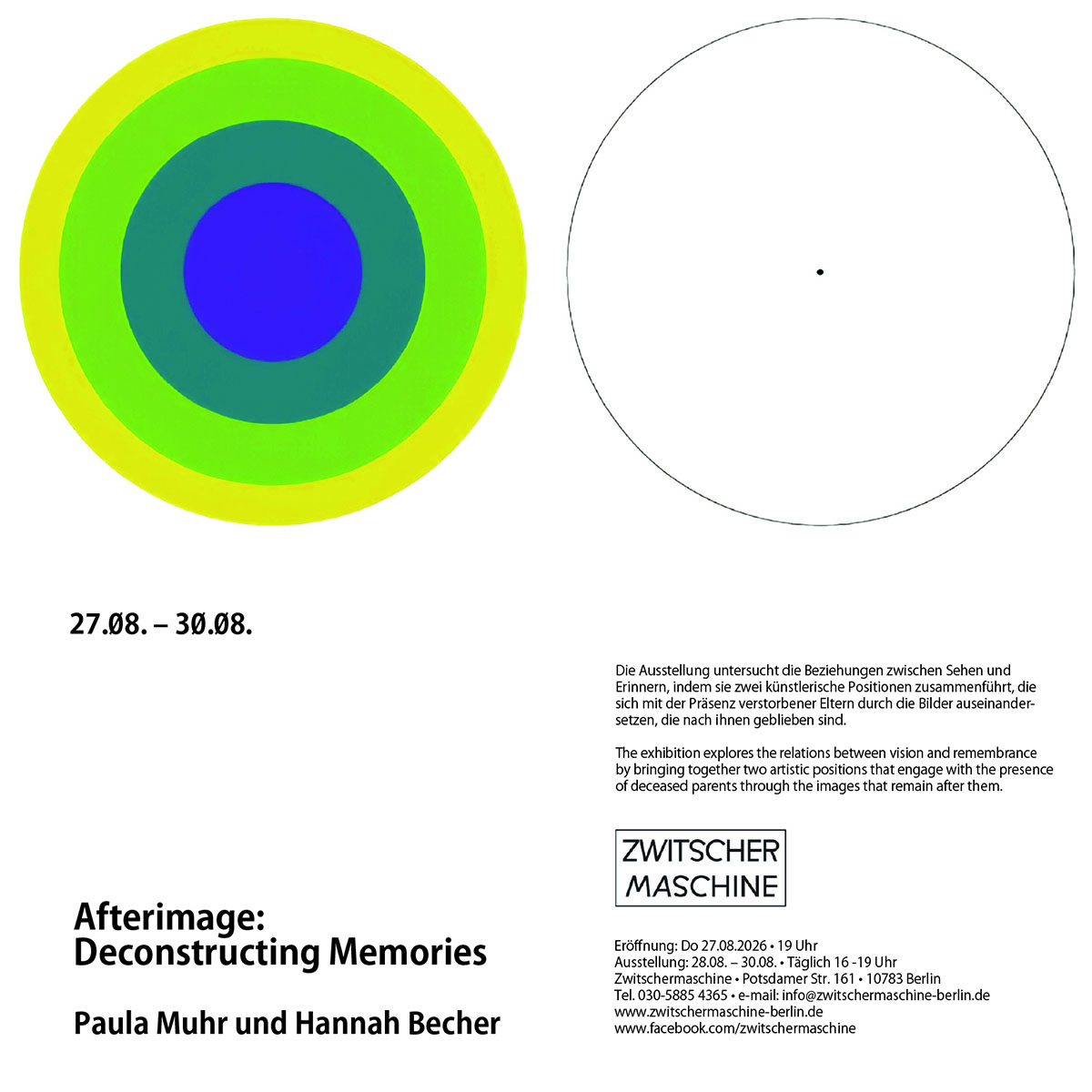
According to the Cambridge Dictionary, an afterimage is “an image of something that you seem to see when you are no longer looking at it or when it is no longer there.” Caused by a temporary adaptation of the visual system, the afterimage is not a reproduction of what was seen, but a transformed trace of something that is no longer present. The term can also serve as a metaphor for memory, as our recollections consist of shifting, fragmented impressions of the past, shaped by loss, subsequent experiences, and imagination. The exhibition Afterimage: Deconstructing Memories explores the relations between vision and remembrance by bringing together two artistic positions that engage with the presence of deceased parents through the images that remain after them.
In the series Blue Memory, Hannah Becher transforms photographs of plants that her mother took in the garden she had cultivated over many years into cyanotypes. Through a physical and process-oriented engagement with this archive, she transforms these personal visual records into new visual forms. In this context, memory functions not as an exact repetition of what once transpired, but as a testimony produced through temporally deferred reenactment. The resulting cyanotypes bear witness to the fact that each memory is unavoidably fragmentary and is merely an echo of an event whose perception has already been shaped by signs and visual language at the very moment we experience it.
In her new work, Tata, Gone (2026), Paula Muhr combines family photographs, images she had made of her father over decades, his own snapshots, newly produced images, and her narrative reflections on their relationship into an evolving multimedia installation. Her aim is not to reconstruct a stable portrait of her father, on whom several of her previous works had focused, but to trace the ruptures, absences, missed opportunities and continued longing for connection that characterise her relationship with her father even after his death. Rather than providing access to her perennially and now permanently absent father, images become a site for rethinking identity, fraught family narratives, and generational silences.
Through processes of selection, translation, and reconfiguration, both artists use image-making as a way of deconstructing memories to explore how our recollections of the past continue to be shaped through our engagement with material and mental images that both persist and keep changing.
The Sky Is Turning – This Is Not Just Another Exhibition About Surrealism
Group · Museum of Modern and Contemporary Art, Rijeka, Croatia
Entering the exhibition The Sky Is Turning feels like taking a step into your own thoughts at the moment when they refuse to be obedient. Occupying the entire gallery space of the Museum, it features about thirty works from its collection – from miniature reliefs and drawings to as previously unexhibited installations – along with the works of five invited artists. Traditional and experimental techniques are combined here with unconventional and unstable materials: salt, hair, leather, sand… Traditional strongholds lose their relevance, and what we usually sweep under the rug is brought to the foreground: contradictory impulses, fears, and desires that both drive and unsettle us. The belief in the economic growth, rational subject and language as a tool of clarity, has been called into question, as evidenced by our time of accelerating crises.
The Sky Is Turning focuses on the unconscious as an inexhaustible topic of artistic research, and the presented works, created from the 1940s to the present day, share some structural components of the Surrealism. However, this is not another exhibition about the Surrealism. Fragmentation of the body and identity, repetition of motifs and associative and enigmatic images, are shaped through diverse artistic aesthetics.
Paula Muhr - Video Works
Solo · Jahrestagung der Arbeitsgemeinschaft Funktionelle Neurologische Störungen, Center of Brain, Behavior and Metabolism (CBBM), Universität zu Lübeck, Lübeck, Germany
Disruptions – Divergent Minds
Group · Frontviews Berlin, Berlin, Germany
Participating Artists: Frauke Boggasch, Kirstin Burckhardt, Alba D’Urbano, Despina Flessa, Ralf Lüddemann / Lukas Marxt / Michael Petri, Paula Muhr, Jakub Šimčik, Annika Stoll Curated by Alba D’Urbano and Jakub Šimčik
11 October-9 November 2024
Auszeichnungen & Förderungen
Wissenschaftspreis 2025 in der Kategorie „Aufsatz“
Gesellschaft für Interdisziplinäre Bildwissenschaft
Rudolf Arnheim Award for Early Career Researchers
Institut für Kunst- und Bilgeschichte, Humboldt-Universität zu Berlin
Publication Grant
Fund of the Faculty of Humanities and Social Sciences, Humboldt University Berlin
Open Access Publication Grant
Publication Funds of the Humboldt University Berlin
Publication Grant
Barbara-Wengeler-Stiftung, Munich
Finalist for the 15th Haus am Kleistpark Art Prize, Berlin
Haus am Kleistpark, Berlin
Exhibition Grant
ifa (Institut für Auslandsbeziehungen), Stuttgart
Artist-in-Residence Grant
Stadt-Atelier, Salzburg
Artist-in-Residence Grant
Centre for Contemporary Art, Celje, Slovenia
FEX-Award for Experimental Photography
Künstlerhaus Dresden
Exhibition Grant
ifa (Institut für Auslandsbeziehungen), Stuttgart
Artists-in-Residence Grant
Shenzhen Fine Art Institute, Shenzhen, China
Autores in seleccion”-Award for Photography
Fotonoviembre, Tenerife, Spain
Artist-in-Residence Grant
Centre national de l’audiovisuel (CNA), Dudelange, Luxembourg